
Discovery
Finding the certificates nobody told you about.
An inventory built only from what CertPilot issued is an inventory of the problem you have already solved. Three engines look elsewhere:
| Looks at | |
|---|---|
| Network scan | What is actually being served, by connecting |
| Certificate Transparency | What a public CA logged for your domains |
| Cloud inventory | What ACM, Key Vault, Google and Kubernetes hold |
Plus a fourth, from the inside: the agent's file inventory.
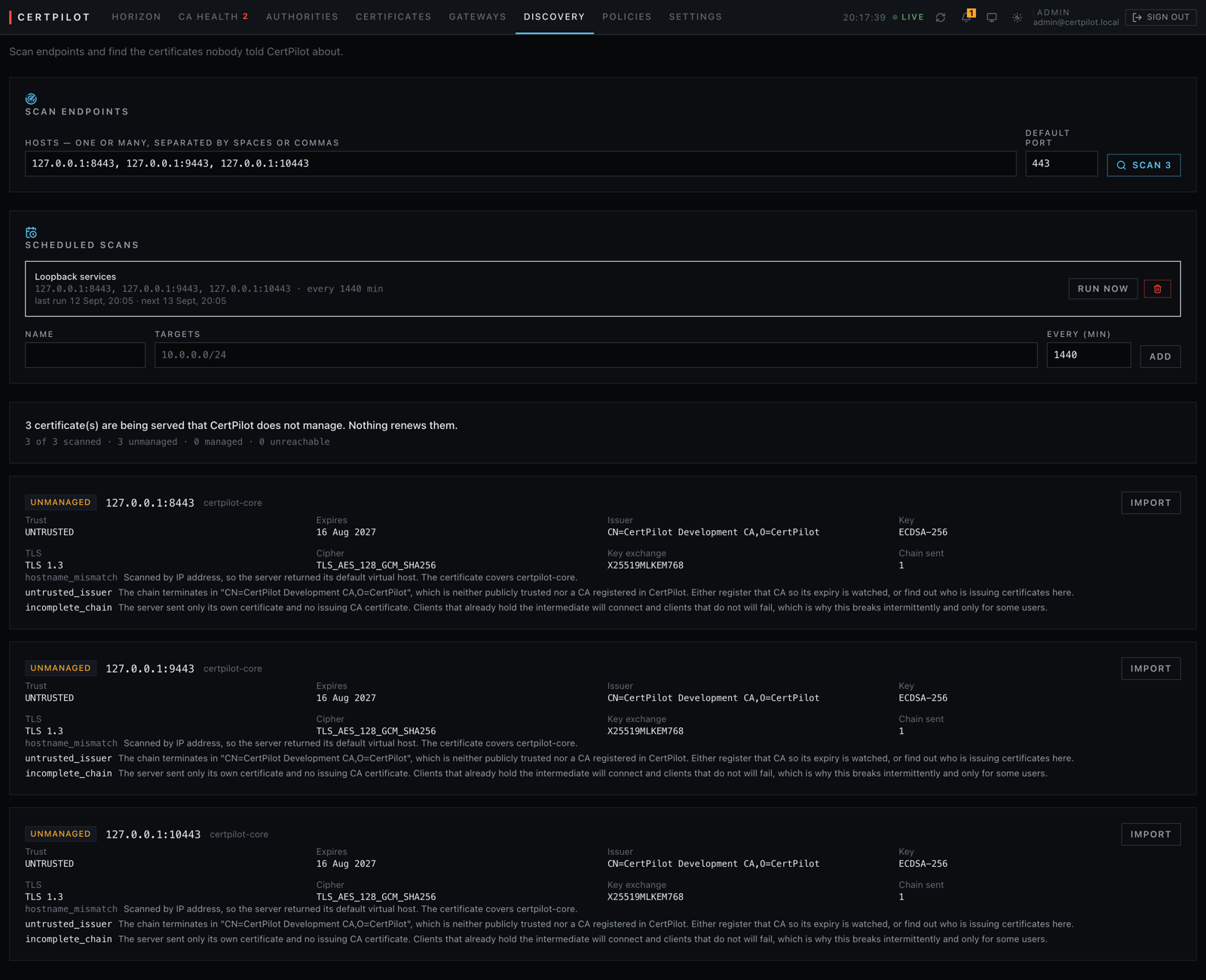
The verdict is the point: "3 certificates are being served that CertPilot does not manage. Nothing renews them." Each finding says what is wrong in a sentence — an untrusted issuer, a chain missing its intermediate, a name that does not match — because "untrusted" alone tells an operator nothing they can act on.
Network scan
These examples carry
-b "$JAR", a cookie jar from signing in. There is no anonymous mode, so a command without a credential is a 401. See Authentication for the one-liner that fills it, or substitute-H "Authorization: Bearer $TOKEN".
curl -b "$JAR" -X POST localhost:8080/api/v1/discovery/scan -H 'Content-Type: application/json' \
  -d '{"targets": ["example.com", "10.0.0.0/24", "internal-api.corp:8443"]}'
Targets can be hostnames, IP addresses, CIDR ranges, or any of those with an explicit port. The scanner opens a TLS connection, completes a handshake, and records what came back.
The output that justifies having run it is one sentence:
6 certificate(s) are being served that CertPilot does not manage. Nothing renews them.A scan of a real estate returns mostly certificates the team issued and already watches. The rows worth reading are the ones nobody knew about, so every result carries a verdict:
| Verdict | |
|---|---|
MANAGED | The fingerprint matches a certificate in the inventory |
UNMANAGED | It does not. Nothing renews this |
UNREACHABLE | No handshake completed |
Matched on fingerprint, not hostname. A host serving a certificate for a name CertPilot manages, from a different certificate, is unmanaged — and that is exactly the case worth surfacing.
The second verdict: what the chain terminates in
| Trust | |
|---|---|
PUBLIC | Verifies against the host's public root store |
INTERNAL | Verifies against a CA registered in CertPilot — so its own expiry is being watched |
SELF_SIGNED | The leaf signed itself. Common on appliances |
UNTRUSTED | Verifies against nothing known |
UNTRUSTED is a finding in its own right: somebody is issuing certificates from an authority nobody has registered.
Scheduled scans
curl -b "$JAR" -X POST localhost:8080/api/v1/discovery/schedules -H 'Content-Type: application/json' -d '{
  "name": "production edge",
  "targets": ["10.0.0.0/24", "edge.example.com"],
  "interval_minutes": 1440}'
The scheduler wakes every minute and runs whatever is due. On an installation with no schedules that is one indexed query a minute.
Re-scanning the same estate is how discovery.changed gets raised — an endpoint serving a different certificate than last time, which is either a renewal you did not make or a change you did not authorise.
Importing a result
curl -b "$JAR" -X POST localhost:8080/api/v1/discovery/import -H 'Content-Type: application/json' \
  -d '{"result_id": "<id>", "environment": "production", "team": "platform"}'
Brings an observed certificate into the inventory so it is tracked and alerted on.
auto_renewis forced false on import, whatever was asked for. Renewal needs a private key and a CA account; an observed certificate has neither, and a record claiming it will renew itself is the failure mode this whole product exists to prevent.
Certificate Transparency
Every publicly trusted certificate is logged. Watching those logs for your own domains finds certificates issued for you that you did not ask for — a shadow-IT team using their own account, or something worse.
curl -b "$JAR" -X POST localhost:8080/api/v1/ct/monitors -H 'Content-Type: application/json' \
  -d '{"domain": "example.com", "include_subdomains": true}'
The monitor polls every minute for monitors that are due, matches what it finds against the inventory by serial number, and raises ct.unmanaged for anything it does not recognise. Serials are compared in one normalised form, because the index pads them and changes their case and the inventory does neither. A certificate's precertificate is recorded and marked, not counted as a second certificate.
make live-ct runs this daily against crt.sh.
This only sees publicly trusted issuance. A private CA does not log to CT, which is why the network scan and the agent inventory exist alongside it.
Cloud inventory
Certificates that a cloud provider holds, which CertPilot did not put there.
| Provider | Reads |
|---|---|
aws_acm | ACM certificates in a region |
azure_key_vault | Key Vault certificates |
gcp | Google Cloud certificates |
kubernetes | TLS secrets in a cluster |
curl -b "$JAR" -X POST localhost:8080/api/v1/cloud/connections -H 'Content-Type: application/json' -d '{
  "name": "production aws", "provider": "aws_acm",
  "config": {"region": "eu-west-1", "access_key_id": "...", "secret_access_key": "..."}}'
Credentials are sealed with the KEK, carry json:"-" on the model so no handler can return them by forgetting to strip them, and are shared with the ACM and Key Vault deployers so one set of credentials serves both inventory and deployment.
The finding that matters
cloud.will_not_renew.
A certificate sitting in ACM or a Key Vault is widely assumed to renew itself. Often it does not, and the reason varies by provider:
| Provider | Renews itself when | Does not when |
|---|---|---|
| ACM | Issued by ACM and in use by an integrated service | Imported |
| Key Vault | A policy with an AutoRenew action exists | Uploaded as a PFX — issuer reads Unknown |
| Google-managed | Self-managed upload | |
| Kubernetes | Something else is managing the secret | Nothing is |
CertPilot reports which. "This certificate in your load balancer will not renew and expires in 34 days" is the sentence, and it is one nobody gets from the provider's own console.
Kubernetes
Give the connection a service account token that can get and list secrets and ingresses.networking.k8s.io, and nothing more, and the cluster's CA as ca_cert:
apiVersion: rbac.authorization.k8s.io/v1
kind: ClusterRole
metadata: {name: certpilot-inventory}
rules:
  - apiGroups: [""]
    resources: [secrets]
    verbs: [get, list]
  - apiGroups: [networking.k8s.io]
    resources: [ingresses]
    verbs: [get, list]
A secret cert-manager issued reads as renewed by cert-manager, from the cert-manager.io/certificate-name annotation cert-manager writes. Anything else reads as renewed by nothing. Without the right to read Ingresses the sync still works, and says it does not know which secrets are attached rather than reporting them all unattached. make live-kubernetes runs all of this against a kind cluster.
What discovery does not do
It does not fix anything. Every engine here produces findings. Acting on one — importing it, binding it to a target, replacing it — is a deliberate step somebody takes.
It does not scan without being asked. There is no default schedule and no built-in target list. Scanning address space is something an organisation authorises.
Coverage of these tables in the conformance suite is thinner than for certificates and deployments. Discovery, CT and cloud-sync tables lean on the in-memory store for their tests, which is where the next defect of the store-divergence class will come from. Recorded in database.md.