
Monitoring and alerting
CertPilot's audience is the central PKI team — the group that owns the CA hierarchy and gets paged when something expires. For them the dashboard is not a convenience, it is the product surface.
One principle drives the whole design:
A dashboard that stops updating must look broken, not healthy.
A frozen screen showing green is worse than no screen, because it manufactures false confidence.
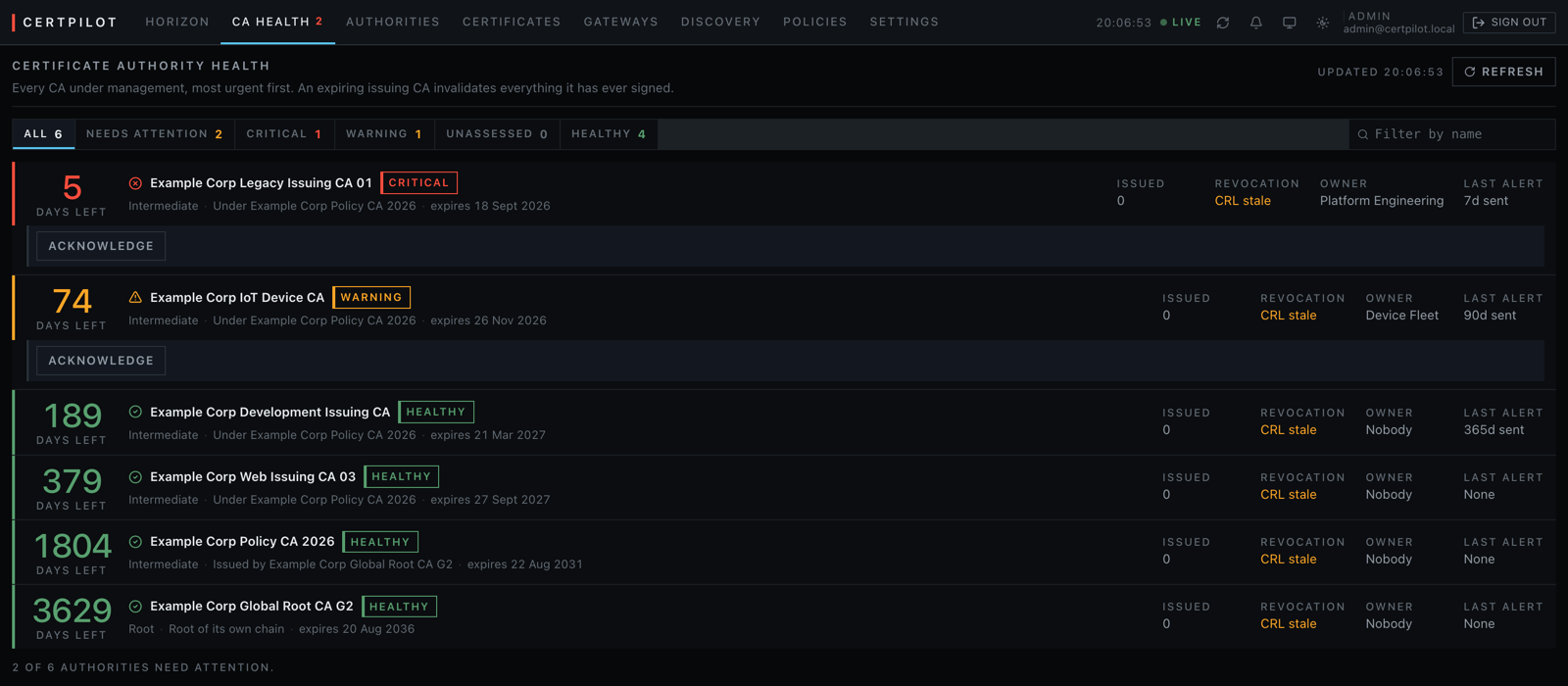
CA health, sorted by urgency. An acknowledged authority keeps its place in the order and is marked rather than hidden — filtering it out is how CAs expire in organisations that believed they were monitoring them.
- CA health
- Expiry thresholds
- The live event stream
- Notification channels
- Acknowledgement and ownership
- Wall displays
- Event topics
CA health
The CA monitor sweeps every registered CA every six hours by default (pki.ca_health_check_interval), and on startup so a freshly started core reports real state rather than what was last persisted.
Per CA it re-parses the certificate, recomputes days remaining, fetches the CRL and checks its freshness, asks the OCSP responder whether the CA itself has been revoked, and evaluates expiry thresholds.
GET /api/v1/pki/authorities?sort=urgencyUrgency sort, worst first, is what the CA health view is built on. For a team watching a screen the useful question is which CA fails first, and an alphabetical list answers a different one.
Status is derived from days remaining:
CRITICAL | ≤ 30 days |
WARNING | ≤ 180 days |
HEALTHY | more |
EXPIRED | past |
UNKNOWN | the certificate could not be parsed |
Where CAs come from
Two ways, and the row records which in source:
Registered by a person (MANUAL) — paste a certificate at POST /api/v1/pki/authorities.
Imported from a gateway (GATEWAY) — connecting a CA account asks its gateway for the issuers behind it and records them. See gateways/vault.md. This is how the CA that actually signs your estate ends up in the same list as the estate.
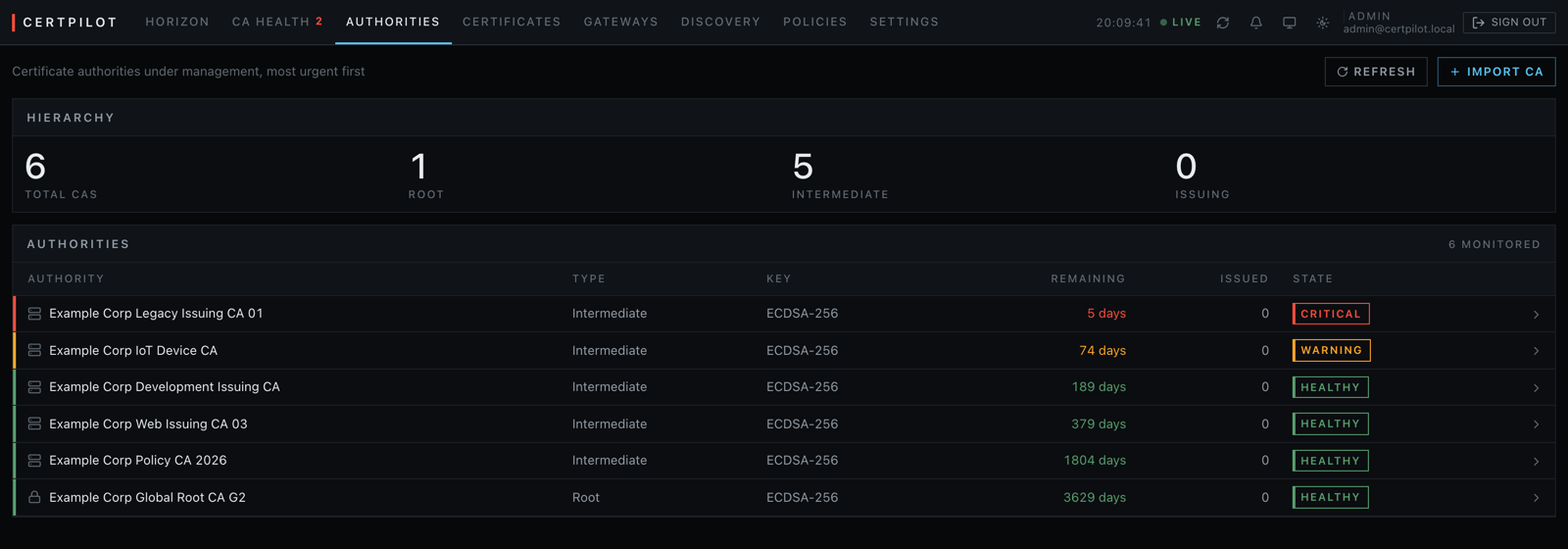
Every CA is on one clock, roots and intermediates together, most urgent first. The issued counts read zero because nothing in this estate was signed through CertPilot — which is not the same as the CA being unused, and is exactly the gap discovery exists to close.
An imported CA is refreshed on a 12-hour sweep, and the sweep never overwrites what an operator decided: the name, the alert thresholds, the owning team, the tags, the notes. A CA rotated out of its mount is not deleted — it signed certificates that are still being served — so last_seen_at goes stale instead.
Expiry thresholds
Each CA carries alert_thresholds, defaulting to:
[365, 180, 90, 30, 14, 7]Crossing one raises ca.expiry_alert once, recorded in last_alert_threshold so it does not fire again every sweep. Severity is CRITICAL at 30 days and below, WARNING above.
Tune them per CA. A root with ten years left does not need a 365-day alert; an issuing CA that signs 90-day certificates needs one well before 90.
Certificates have their own lead days rather than thresholds — see configuration.md.
The live event stream
GET /api/v1/events
Accept: text/event-stream
Server-Sent Events, not WebSockets: one-way traffic, survives proxies, and browsers reconnect on their own.
On connect the server sends a snapshot, so a client never renders from an empty store, then deltas. A comment heartbeat every 15 seconds keeps the connection alive and lets a client judge freshness by data age rather than by whether a socket has errored.
Last-Event-ID is honoured on reconnect.
Slow consumers
The broker's policy is bounded buffer, drop oldest, mark the subscription lossy. A wall display on a flaky link must never apply backpressure to the CA health sweep. A lossy subscription is told to re-fetch a snapshot rather than being fed a gap it cannot detect.
Proxies
proxy_buffering off is mandatory. See operations.md — this is the single most common way to end up with a dashboard that looks fine and has stopped updating.
Notification channels
Three types, deliberately not more:
| Type | |
|---|---|
slack | Incoming webhook, Block Kit formatting |
webhook | Generic receiver, HMAC-SHA256 signed |
email | SMTP with STARTTLS |
These examples carry
-b "$JAR", a cookie jar from signing in. There is no anonymous mode, so a command without a credential is a 401. See Authentication for the one-liner that fills it, or substitute-H "Authorization: Bearer $TOKEN".
curl -b "$JAR" -X POST localhost:8080/api/v1/notification-channels -H 'Content-Type: application/json' -d '{
  "name": "pki-oncall", "channel_type": "slack",
  "severity_threshold": "CRITICAL",
  "topics": ["ca.expiry_alert", "ca.discovered", "cert.not_deployed"],
"config": {"webhook_url": "https://hooks.slack.com/services/..."}}'| Field | |
|---|---|
severity_threshold | INFO, WARNING, CRITICAL. Below this, nothing is sent |
topics | Empty means every topic. Otherwise an allow-list |
Configuration is sealed with the KEK. The dispatcher subscribes to the broker rather than being called inline, so a wedged Slack webhook cannot stall the CA health sweep. Failures retry with backoff and are written to the audit log as notification.failed.
Watch for
notification.failed. A monitoring system whose alerting is broken is worse than none, because it is trusted.
Acknowledgement and ownership
curl -b "$JAR" -X POST localhost:8080/api/v1/pki/authorities/$ID/acknowledge \
  -H 'Content-Type: application/json' \
-d '{"note": "rotation scheduled for the 3rd", "silence_until": "2026-09-03T00:00:00Z"}'curl -b "$JAR" -X PUT localhost:8080/api/v1/pki/authorities/$ID/owner \
-H 'Content-Type: application/json' \
-d '{"owner_team": "platform-security", "owner_email": "pki@example.com"}'One rule, and it is not negotiable:
Silencing suppresses delivery, never display.
An acknowledged CA still appears on the dashboard, marked as acknowledged and by whom. Hiding a problem because somebody clicked a button is how CAs expire in organisations that believed they were monitoring them.
Owner is free text. Team names and distribution lists do not live in CertPilot, and a foreign key to something it does not own would mean either an import step or a wrong answer on a row somebody is reading at 2am.
Wall displays
A screen in a corridor that nobody logs into needs a credential that cannot do damage if the screen is stolen.
curl -b "$JAR" -X POST localhost:8080/api/v1/display-tokens -H 'Content-Type: application/json' -d '{
  "name": "corridor-screen", "expires_at": "2027-01-01T00:00:00Z"}'
The raw token is returned once. Only a SHA-256 hash is stored.
Then point the display at:
https://certpilot.example.com/display?display_token=<token>What the token can do:
| Role | viewer, hardcoded — not configurable, not derivable from input |
| Methods | GET only, plus the SSE endpoint |
| Never | /certificates/:id/private-key, or any write route |
| Presented as | ?display_token= or X-Display-Token |
| Recorded | last_seen_at, last_seen_ip — so a leaked token is visible |
| Revocable | DELETE /api/v1/display-tokens/:id, admin only, audited |
The query-string form is necessary because EventSource cannot set headers. That is also why the request logger never writes query strings.
Event topics
| Topic | Raised when |
|---|---|
ca.health | A CA's status changes |
ca.expiry_alert | A CA crosses an expiry threshold |
ca.discovered | A gateway reported a CA that was not in the inventory |
cert.issued | A certificate was issued |
cert.renewed | A certificate was renewed |
cert.renewal_failed | A renewal attempt failed |
cert.renewal_window_moved | A CA changed its RFC 9773 renewal window — materially forward means it is facing a mass revocation |
cert.not_deployed | A renewed certificate is not being served |
cert.deployed | A deployment succeeded |
cert.deploy_failed | A deployment failed |
agent.enrolled | A host joined |
agent.stale | A host stopped reporting |
agent.key_exposed | A private key on a host is group- or world-readable |
agent.key_mismatch | A certificate and the key beside it do not match |
agent.unmanaged | A host holds a certificate CertPilot does not know |
agent.request_refused | A host asked for a name no grant covers |
agent.install_failed | An install on a host failed |
agent.install_unfulfilled | A destination asked for a certificate the host does not hold |
discovery.unmanaged | A scan found a certificate nothing renews |
discovery.changed | An endpoint is serving a different certificate |
discovery.progress | Scan progress, for the UI |
ct.unmanaged | A Certificate Transparency log shows a certificate for your domain that you did not issue |
cloud.unmanaged | A cloud provider holds a certificate CertPilot does not know |
cloud.will_not_renew | A cloud provider will not renew a certificate everyone assumes is automatic |
Severity is INFO, WARNING or CRITICAL, matching the vocabulary the CA monitor and the frontend both use.